
MORE THAN A DIAGNOSIS: BUILDING A SCHOOL COMMUNITY OF UNDERSTANDING AND INCLUSION
August 21, 2026 2026-08-21 15:19MORE THAN A DIAGNOSIS: BUILDING A SCHOOL COMMUNITY OF UNDERSTANDING AND INCLUSION
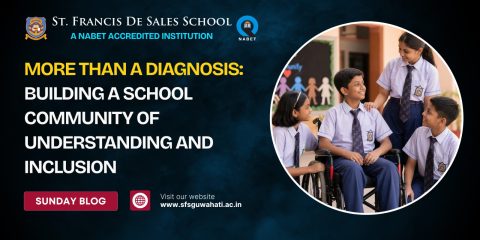
A school is a place where children learn about mathematics, languages, science and the world around them. But some of the most important lessons cannot be found in a textbook. They are lessons about empathy, dignity, respect and understanding.
August is observed as Spinal Muscular Atrophy (SMA) Awareness Month, providing an opportunity to learn about a condition that can affect the motor nerve cells responsible for muscle movement and can impact activities such as breathing, eating, crawling and walking.
Yet awareness should not stop at knowing the name of a condition.It should lead us to ask a more important question:
How can we create environments where every child feels that they belong?
Seeing the Child Before the Diagnosis
When a child has a disability or a medical condition, it can sometimes become the first thing others notice about them. But a child is never defined by a diagnosis.They are also a friend, a learner, a dreamer, a classmate, an artist, a sportsperson, a storyteller, a problem-solver and a person with hopes, interests and ambitions.
True inclusion begins when we learn to see the whole child rather than focusing only on what may be different.
For students living with SMA or other disabilities, participation may sometimes require adaptations, additional support or more time. Providing these is not about giving someone an unfair advantage. It is about ensuring that every learner has a meaningful opportunity to participate.
Inclusion Is More Than Physical Access
An accessible ramp or suitable classroom arrangement is important, but inclusion goes beyond physical accessibility.It is also about belonging.
Does a child feel comfortable participating in a group activity?
Can they contribute to classroom discussions?
Are their peers encouraged to understand and respect differences?
Are activities designed with different abilities and needs in mind?
Does the child feel that they are a valued member of the school community?
These questions remind us that inclusion is not simply about bringing children into the same room.
It is about making sure they feel that the room belongs to them too.
Teaching Children to Understand Differences
Children are naturally curious about differences. When they see someone using a wheelchair, moving differently or requiring additional assistance, they may have questions.
Rather than avoiding those conversations, adults can use them as opportunities for age-appropriate learning.
Children can be taught that people may communicate, move, learn or participate in different ways and that difference is not something to fear or ridicule.
Simple lessons in empathy can have a lasting impact:
- Ask before helping rather than assuming someone needs help.
- Use respectful language.
- Include everyone in games and group activities wherever possible.
- Never make someone's disability the subject of jokes.
- Be patient when someone needs more time.
- Celebrate abilities and interests rather than focusing on limitations.
These are not merely lessons about disability.
They are lessons about being a good human being.
The Role of Schools and Educators
An inclusive school does not expect every learner to fit into exactly the same mould. Instead, it looks for ways to remove unnecessary barriers to participation and learning.
Teachers, special educators, counsellors, administrators and peers each have a role to play. Thoughtful classroom adaptations, appropriate support, accessible activities, peer sensitisation and open communication with families can make a significant difference.
Most importantly, inclusion should be part of everyday school culture, not something discussed only during an awareness month. August may provide the opportunity to start the conversation, but inclusion is something we practise throughout the year.
From Awareness to Action
Awareness tells us that something exists.
Understanding helps us recognise what it may mean for another person.
Inclusion asks us to consider what we can do differently.
That progression matters.
SMA Awareness Month gives us an opportunity to learn, listen and become more conscious of the experiences of individuals and families living with SMA. It also reminds us that creating a supportive community requires more than information, it requires empathy and action.
A school community becomes stronger when students learn that equality does not always mean treating everyone identically. Sometimes, fairness means providing different kinds of support so that everyone has the opportunity to participate, learn and flourish.
The most powerful message we can give a child is simple:
You belong.
You belong whether you learn quickly or need more time.
You belong whether you walk, use mobility support or move differently.
You belong whether you speak confidently or communicate in another way.
You belong because your presence, ideas, friendships and dreams matter.
As we observe SMA Awareness Month this August, let us move beyond simply knowing about a condition. Let us use the opportunity to build greater understanding of disability, encourage respectful conversations and strengthen a culture where differences are met with empathy rather than assumptions.
Because the true measure of an inclusive school is not simply how well it accommodates differences.
It is how naturally every child is made to feel that they belong.
At St. Francis De Sales School, Guwahati, we believe that education is not only about academic growth but also about developing compassionate, respectful and responsible individuals. Awareness initiatives such as SMA Awareness Month provide meaningful opportunities for our school community to learn about differences, challenge assumptions and strengthen our commitment to creating an environment where every learner is valued, supported and included.