
MORE THAN HOMEWORK: SMALL DAILY HABITS THAT BUILD LIFELONG LEARNERS
August 8, 2026 2026-08-08 9:55MORE THAN HOMEWORK: SMALL DAILY HABITS THAT BUILD LIFELONG LEARNERS
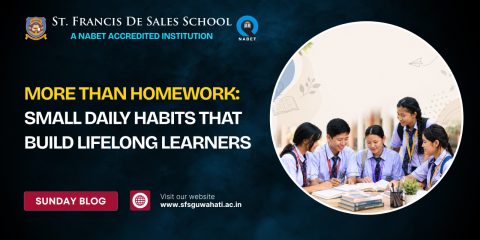
Homework has long been a familiar part of a child's school routine. Complete the worksheet, revise the chapter, learn the answers, pack the school bag and repeat.
But education is much bigger than completing assignments.
The real purpose of learning is not simply to help children remember what they were taught today. It is to help them become people who know how to learn, how to think, how to question, and how to keep growing even when there is no teacher standing beside them.
The good news is that lifelong learning does not require complicated routines. It begins with small habits practised consistently at home and at school.
1. Make Reading a Daily Habit
Reading should not be limited to textbooks or examination preparation.
A child who spends even 15–20 minutes reading every day develops vocabulary, imagination, concentration and the ability to understand different perspectives. The reading material could be a storybook, newspaper article, biography, magazine, comic, science article or age-appropriate digital content.
The goal is not to finish a certain number of pages. It is to develop the habit of asking:
“What can I discover today?”
Parents can make reading more enjoyable by allowing children to choose some of their own books and occasionally discussing what they have read.
2. Encourage Questions, Even the Unexpected Ones
Children are naturally curious. Why does the moon change shape? Why do we need traffic rules? How does an aeroplane fly? Why can't we see air?
These questions may sometimes interrupt a busy day, but they are opportunities for learning.
Instead of always providing immediate answers, parents can sometimes respond with:
“What do you think?”
This encourages children to observe, reason, research and form their own explanations.
A child who learns to ask good questions is already learning how to learn.
3. Give Children Small Responsibilities
Lifelong learners need more than knowledge. They need independence.
Simple responsibilities: organising their study table, packing their school bag, maintaining a reading list, keeping track of assignments, arranging books or planning what they need for the next day, help children develop ownership.
When adults do everything for children, tasks may get completed faster, but opportunities to develop responsibility are lost.
Let children experience the satisfaction of saying:
“I planned it. I did it. I managed it.”
4. Turn Everyday Life into a Classroom
Learning does not stop when the school bell rings.
Cooking can introduce measurements and fractions. Shopping can involve budgeting and mental mathematics. A family journey can become an opportunity to explore geography and history. Gardening can lead to conversations about soil, plants, weather and sustainability.
Even a simple walk can encourage children to observe birds, trees, buildings, traffic patterns and changes in their surroundings.
The world is full of lessons when children are encouraged to notice them.
5. Teach Children to Reflect, Not Just Remember
After completing a task, children often ask, “Is it correct?”
A more powerful question is:
“What did you learn from doing it?”
Reflection helps children understand their own learning process.
Parents can ask:
- What was easy for you today?
- What was challenging?
- What mistake taught you something?
- What would you do differently next time?
- What are you curious to learn more about?
These conversations gradually develop self-awareness and help children become more independent learners.
6. Normalise Mistakes
Children who are afraid of making mistakes may eventually become afraid of trying.
A wrong answer, a failed experiment, a poor result or an unsuccessful attempt does not have to be the end of learning. It can be the beginning of better understanding.
Instead of focusing only on “You got it wrong,” adults can ask:
“What can we learn from this?”
When mistakes are treated as part of the learning process, children become more willing to experiment, solve problems and try again.
7. Build the Habit of Finishing What They Start
In a world of constant notifications, short videos and instant entertainment, sustained attention is becoming an increasingly valuable skill.
Children can gradually develop this through simple practices: finishing a book chapter, completing a puzzle, working on a craft project, practising an instrument or staying with a challenging problem instead of immediately giving up.
The objective is not perfection.
It is persistence.
A lifelong learner understands that some things take time.
8. Let Children Explore Their Interests
Not every valuable learning experience comes from the prescribed curriculum.
A child fascinated by space may want to learn about planets. Another may spend hours understanding how machines work. Someone else may enjoy drawing, coding, cooking, music, sports or storytelling.
These interests can become powerful pathways to learning.
Parents can support this curiosity by providing opportunities to explore rather than deciding that only traditionally academic activities are worthwhile.
Sometimes, a child's hobby is the beginning of a lifelong passion.
9. Encourage Children to Teach Someone Else
One of the simplest ways to strengthen understanding is to explain something to another person.
Ask your child to explain a science concept, tell you about a historical event, teach a sibling a new game or explain how they solved a mathematics problem.
When children teach, they have to organise their thoughts, identify what they understand and recognise what they still need to learn.
In other words, they become active participants in their own learning.
10. End the Day with One New Learning
A simple family ritual can make learning part of everyday conversation:
“What is one new thing you learned today?”
It does not have to be something from a textbook.
It could be:
- a new word,
- an interesting fact,
- a new skill,
- something about another person,
- a mistake they understood,
- or even something they discovered about themselves.
Over time, children begin to recognise that learning is happening everywhere, not only during lessons.
Raising Learners, Not Just Students
Marks matter. Homework matters. Academic achievement matters.
But they are only parts of a much larger educational journey.
The children who thrive in a rapidly changing world will need to do more than remember information. They will need to think critically, communicate clearly, adapt to change, solve problems, work with others, remain curious and continue learning throughout their lives.
These abilities are not developed overnight. They grow through everyday experiences and repeated habits.
A few minutes of reading.
A thoughtful question.
A responsibility completed independently.
A mistake discussed without fear.
A new interest explored.
A problem patiently solved.
A conversation about what was learned.
These may seem like small things.
But small habits, practised consistently, can shape big futures.
Because ultimately, the goal of education is not simply to prepare children for the next examination or the next grade.
It is to prepare them for a lifetime of learning.
At St. Francis De Sales School, Guwahati, we believe that meaningful education extends beyond textbooks and examinations. Through academic learning, experiential opportunities, co-curricular activities, collaboration and reflection, we strive to nurture learners who are curious, responsible, confident and prepared to continue learning long after they leave the classroom.