
THE INVISIBLE BACKPACK: WHAT CHILDREN CARRY BESIDES BOOKS
August 1, 2026 2026-08-01 9:55THE INVISIBLE BACKPACK: WHAT CHILDREN CARRY BESIDES BOOKS
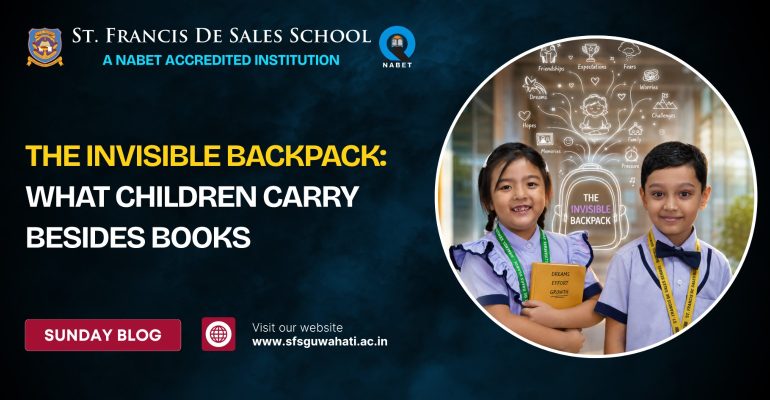
As the school settles into its rhythm once again after the summer vacation, children return to classrooms carrying neatly packed school bags filled with books, notebooks, lunch boxes, and stationery. Yet, there is another backpack they bring with them every single day; one that cannot be seen but is often far heavier. It is filled with emotions, experiences, expectations, friendships, fears, hopes, and memories.
This invisible backpack influences how children learn, behave, interact with others, and respond to challenges. While teachers can see completed assignments and examination scores, what truly shapes a child's learning journey often lies beneath the surface.
Every Child's Invisible Backpack Is Different
No two children begin their school day carrying the same emotional load. One child may walk into class excited after spending quality time with family over the weekend. Another may arrive feeling anxious after witnessing conflict at home. Some children return after overcoming illness, while others struggle silently with academic pressure, loneliness, or the fear of not fitting in.
Children rarely announce these feelings. Instead, they communicate them through their behaviour. A child who seems distracted may actually be overwhelmed. One who appears unusually quiet may simply be longing for reassurance. Another who reacts with frustration may be struggling to express emotions that they themselves do not fully understand.
Behaviour is often communication in disguise.
What Might Be Inside the Invisible Backpack?
The contents differ from child to child, but they often include:
- The excitement of meeting friends again.
- The pressure to perform well in academics.
- Worries about examinations or homework.
- Fear of making mistakes or disappointing parents.
- New friendships and changing social circles.
- Family changes or responsibilities at home.
- Comparisons with siblings or classmates.
- Exposure to social media and digital influences.
- Dreams, ambitions, and personal goals.
- Questions about identity, belonging, and self-worth.
Even positive experiences can feel overwhelming. A child taking on a leadership role, participating in competitions, or joining a new class may experience both excitement and nervousness at the same time.
Looking Beyond Behaviour
It is natural for adults to notice behaviour first. However, behaviour is often the final chapter of a story we have not yet read.
A child who forgets homework repeatedly may not be careless. They could be struggling with organisation, emotional stress, or changes in routine. A student who interrupts frequently may not simply be seeking attention but could be eager to connect or express ideas. A sudden drop in participation or academic performance may indicate that something beyond the classroom is demanding the child's emotional energy.
When parents and teachers choose curiosity over assumptions, they create opportunities to understand rather than judge.
Instead of asking, "Why is this child behaving this way?", it is often more helpful to ask, "What might this child be experiencing?"
That simple shift can transform relationships and open the door to meaningful support.
The Role of Parents
Children do not always need solutions; they often need someone who is willing to listen without immediately correcting or comparing them.
Parents can help lighten the invisible backpack by:
- Creating a safe space for daily conversations.
- Asking open-ended questions such as, "What made you smile today?" or "Was there anything that felt difficult?"
- Celebrating effort as much as achievement.
- Avoiding constant comparisons with other children.
- Maintaining predictable routines that help children feel secure.
- Encouraging healthy screen habits and adequate sleep.
These small daily moments build emotional trust, making it easier for children to share concerns before they become overwhelming.
The Role of Schools
Schools are more than places where academic knowledge is shared, they are communities where children grow emotionally, socially, and morally.
A welcoming classroom, a teacher who notices subtle changes, opportunities for collaboration, encouragement during setbacks, and meaningful co-curricular experiences all contribute to reducing the weight children carry. When schools nurture curiosity instead of fear, confidence instead of comparison, and inclusion instead of competition, children begin to feel safe enough to learn, ask questions, and grow into their authentic selves.
This reflects the vision of holistic education promoted under the National Education Policy (NEP) 2020, where education is not measured solely by marks but by the development of compassionate, resilient, and responsible individuals.
Walking Beside Our Children
Every morning, children walk through the school gates carrying two backpacks: one visible and one invisible.
We can easily help organise the books in one. The other requires something far more valuable: patience, empathy, encouragement, and understanding.
When adults recognise that every behaviour has a story, every emotion deserves acknowledgement, and every child benefits from being truly seen, schools become places where children do more than achieve academic success; they discover confidence, resilience, and belonging.
As parents and educators, perhaps the most meaningful question we can ask is not "Is your school bag packed?" but "How are you feeling today?"
Sometimes, helping a child unpack their invisible backpack is the first step towards helping them realise their fullest potential.
At St. Francis De Sales School, Guwahati, we believe that education extends beyond textbooks and classrooms. By nurturing every child's emotional well-being alongside academic excellence, we strive to create a learning environment where every learner feels valued, understood, and empowered to flourish.